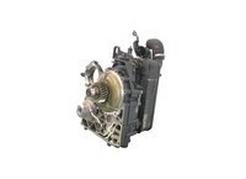
What is a retarder on a truck?
A retarder is an auxiliary braking system that allows a truck to slow down for extended periods without continuously using the normal wheel brakes. The retarder acts on the drivetrain and therefore slows down the driven wheels. The system is mainly used during long descents, when approaching traffic or when the driver wants to reduce speed gradually.
Many trucks use a hydrodynamic retarder. Inside this type of retarder, a rotor rotates through a fluid, usually oil or coolant. The fluid is directed towards a stationary stator, creating resistance and slowing down the drivetrain. The kinetic energy is converted into heat, which is dissipated through the cooling system.
The driver usually operates the retarder using a lever with several braking levels. In modern trucks, the system can also work automatically together with the cruise control, engine brake and service brakes. A retarder is designed to support the normal brakes, not to replace them completely. During an emergency stop or when bringing the truck to a complete standstill, the drum or disc brakes are still required.
What is an intarder on a truck?
An intarder is a retarder that is integrated into the gearbox. The name Intarder is mainly used by transmission manufacturer ZF for its integrated hydrodynamic braking system.
Like other hydrodynamic retarders, an intarder uses fluid resistance to slow down the drivetrain. Its defining feature is therefore not a different braking principle, but the location in which the system is installed. Because the intarder is built into the transmission, it forms one compact unit with the gearbox. This allows the system to be connected to the transmission control, cruise control and electronic brake management system of the truck.
In practice, the term in-retarder is sometimes used, but the standard technical term is intarder.
What is the difference between a retarder and an intarder?
Retarder is the general term for an auxiliary braking system that slows down the drivetrain of a truck. An intarder is a specific type of retarder that is integrated into the gearbox.
Another retarder may be installed as a separate unit on or behind the gearbox. An intarder, on the other hand, forms part of the transmission design. Both systems can operate hydrodynamically and have the same main purpose: slowing the truck down for extended periods and reducing the load on the normal brakes.
The difference therefore mainly lies in the design and installation:
- A retarder is the general product category.
- An intarder is a retarder integrated into the transmission.
- Not every retarder is an intarder, but every intarder is a retarder.
Which version is suitable for a truck depends on factors such as the make and type of gearbox, the drivetrain and the vehicle configuration. An intarder therefore cannot simply be installed on every transmission.
What are the benefits of a retarder or intarder?
The main benefit of a retarder or intarder is that the service brakes are used less frequently and are subjected to less strain. During long descents in particular, the driver can control the vehicle’s speed without continuously pressing the brake pedal. This reduces wear on components such as brake pads, brake discs and brake drums. Manufacturers indicate that, when used correctly, a retarder can take over a large proportion of regular braking actions.
A retarder also offers the following benefits:
- Lower risk of overheated brakes: the service brakes remain cooler and therefore retain their braking performance more effectively.
- More control during descents: the driver can maintain a more consistent speed, especially when carrying a heavy load.
- Lower maintenance costs: because the service brakes wear less quickly, brake components generally need to be replaced less often.
- Greater driving comfort: the braking force can be increased in several stages, allowing the truck to slow down gradually.
- Better cooperation between systems: in modern trucks, the retarder can work together with the cruise control, engine brake and service brakes.
The actual braking force depends on factors such as the driving speed, selected gear, type of retarder and cooling system temperature. If the system becomes too hot, the control unit may temporarily reduce the braking force to prevent overheating.
Is a retarder or intarder the same as an engine brake?
No, a retarder or intarder is not the same as an engine brake. Both systems slow down the truck without relying solely on the service brakes, but they do so in different ways.
An engine brake uses the resistance of the engine to slow down the truck. Depending on the system, this may be achieved by restricting the exhaust gas flow or adjusting the engine’s valve operation. The braking effect of an engine brake therefore depends heavily on the engine speed: a higher engine speed generally provides more braking power.
A retarder slows down the drivetrain using a separate braking system located in or near the transmission. In a hydrodynamic retarder, the braking force is generated by fluid resistance between a rotor and stator. An intarder works according to the same principle but is integrated into the gearbox.
The systems can complement each other. Modern trucks often combine the engine brake and retarder automatically, with the normal wheel brakes only being applied when additional braking force is required. An engine brake is generally more common and mechanically simpler, while a retarder can provide a high and consistent braking force for extended periods.